
Wednesday, June 22, 2011
I2C Rant
Just wondering why the I2C Users Manual/Spec doesn't have this picture in it. This is exactly what I was looking for to determine how much rise time my I2C signals can tolerate. Section 6.2 does cover this a bit, but I like pretty plots.


The passing of two Greats!
Two great role models of mine have passed. I have enjoyed reading their articles and getting the opportunity to sit in on one of Bob's "Analog Power Point" presentations at Arrowfest a few years ago.
Bob Pease
Jim Williams
It will be interesting to see who will fill these shoes at Electronic Design and EDN; there are no shortage of talented Application Engineers, but I wonder if ..... In today's fast paced do more with less engineering depts; can someone obtain the "depth" of knowledge to replace Bob & Jim in a world that requires so much "breath" of knowledge to be successful.
I like Chris's spin on this topic.
P.S my favorite Programming Language is solder as well :)
Bob Pease
Jim Williams
It will be interesting to see who will fill these shoes at Electronic Design and EDN; there are no shortage of talented Application Engineers, but I wonder if ..... In today's fast paced do more with less engineering depts; can someone obtain the "depth" of knowledge to replace Bob & Jim in a world that requires so much "breath" of knowledge to be successful.
I like Chris's spin on this topic.
P.S my favorite Programming Language is solder as well :)
Sunday, June 12, 2011
It's ALIVE!!!!
My hacked up circuit for the Touchstone Semiconductor TS1001 Opamp Design Contest works!!!! I wasn't too worried about it working, but I wasn't sure if I could squeak under the 1V @ 5uA power consumption requirement the design contest entries must meet.... I've got 0.5uA to spare. Like Dave Jones says "I could fly half way to the moon on 0.5uA"
 More details to come, but I have a board to layout, video to shoot, and documentation to pull together before I can divulge all the details.
If you haven't signed up for the design contest; sign up deadline is the end of June and entries must be in by July 29th.

If you haven't signed up for the design contest; sign up deadline is the end of June and entries must be in by July 29th.
Saturday, June 11, 2011
Extra Large Seven-Segments
I was digging through my closet of goodies the other day and found several extra large seven segment displays. I glued them together and wired them up to make a nice new sign for my office.


 I used some 100 Ohm DIP resistor networks for series current limiters and hot glued them to the back of the displays. Not super high techy since I hardwired the "Eric", but I figure I could easily wire up the rest of the segments and drive them via my new Arduino.... maybe a project for a rainy day.


Saturday, June 4, 2011
Arduino, Open Source Sexyness!
I just got my Arduino Uno board in the mail this week and I am pumped. Why would a guy whose designed embedded platforms around a dozen or so different micros be interested in a "Beginner" Atmel AVR platform. Other than it's cool.... I've been looking for a new embedded platform for my home/hobby projects.


Back 8 years ago or so I fell in love with the Zilog Z8 microcontroller it had a ton of application notes and software code samples which made hobby projects a ton easier to implement. I have always considered myself a Hardware guy, but I can blink LEDs, light up Character Displays, and talk to SPI and I2C peripherals without too much trouble. But I always love it when I have a really well written software oriented app note to help me along. I started to steer away from Zilog, because even though they were great for my "hobby" projects I didn't see myself using these parts in a commercial product, for my day job.
Then back in 2006 or so I managed to get my hands on one of these cute dev kits, Silicon Labs C8051F300 Toolstick.


This was one of the first USB based Devkits that I noticed on the market, I am pretty sure it even came out before the TI MSP430 one. I loved the concept of an extremely low cost dev kit to get me started. Silicon Labs has a reasonably good IDE and a Keil 4KB code limited version of the 8051 compiler to get you started. The 4KB limit bugged me because I had 8KB of Flash to use up, so I quickly switched over to the open source SDCC 8051 compiler and even though the code wasn't compiling near as tight I was happy. But then Silicon labs forgot about the hobbyists and discontinued the PDIP package version of the parts and left me with the QFN/"Belly" pad commercial parts.... this sucked! I have relatively good soldering skills and even though I have successfully soldered these types of parts on boards hundreds of times.... I just didn't want to screw around with that anymore.
I came late to the Cypress PSoC party; these parts were already being used in a ton of commercial products and almost every other Circuit Cellar article used a PSoC as well. The IDE was free, the Imagecraft M8C compiler was essentially free, and best of all they still offered the parts in PDIP and non-belly pad SMT versions.... thank you Cypress!!!! I have used PSoC's in a half a dozen or so commercial products and just as many small hobby projects. There is a bit of a front-end loaded learning curve with the PSoC, but that is compensated by the huge app note offering and public support in the forums. The thing I love about PsoC is how configurable it is, the thing I hate about PSoC is how configurable it is.... most times I don't need 12 configurable analog blocks and a butt load of digital blocks, I need a simple 8-bit micro to bang out commands out of a serial port or toggle a few GPIOs.... so the PSoC is a bit of over kill for most of my hobby projects.
The Arduino is an open source hardware platform based off the Atmel 8-bit AVR Microcontroller. The micro has a Serial (USB Device) based boot-loader pre-installed in the AVR, so no external programmer/debugger is needed to program the device. The Arduino team (a handful of Italian dudes) also created an open source IDE that makes use of the GCC AVR compiler. The cool thing is this IDE & Compiler runs perfectly on Windows or Linux...... So I am programing an open source hardware platform, using an open source IDE & compiler, that is running on my open source Ubuntu Linux distribution; now that is sexy!!!!

Now open source is cool, but how well does it work? All I can say is within 5 mins of pulling my Arduino Uno out of the package I downloaded one of the example "Blinky" light projects (Sketch) and had a blinky LED going. Within 15mins I had a Parallax Serial 16x2 LCD up and going.... I remember spending most of my Christmas vacation getting a character LCD lite up on an MC68HC11 eval board in college. To be honest it took me longer to find the Parallax Serial LCD command to turn off the blinking cursor than it did for me to get the Arduino running. The IDE is very intuitive and there are a ton of forums and resources for this platform.


Some great Arduino resources are listed below:
http://www.arduino.cc/
http://jeremyblum.com/category/arduino-tutorials/
http://www.adafruit.com/
http://www.sparkfun.com/
Tuesday, May 31, 2011
Altoids Audio splitter hack
I needed a quick 2-to-1 1/4" Stereo Jack box for the Church's sound board. This should do the trick!
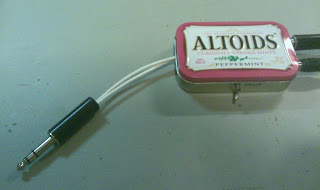
 The switch either shorts both Jack's Left and Right Channels together or just selects the Right from one jack and the Left from the other jack. I wasn't sure if shorting the channels together would effect the audio quality due to extra loading, so I put the switch in so I could play around with it.
 In a nice minty fresh shielded Altoids Box :)


Saturday, May 28, 2011
Tweets keep me Current
My company recently hired an EE intern to work with me and help fix all my mistakes this summer :) He is very bright and extremely motivated to learn knew things. One of our conversations made me start thinking about all the things I do to try and keep myself learning new things.
I work at a company that has a relatively small Electrical Engineering group, so I have had to rely on reading publications and allow myself to be taken out to dinner by an occasional vendor to stay current with the latest electronic component offerings.
Trade Mags are a great way to keep up on the technology:
EETimes is more of a current events type mag.
http://www.eetimes.com/
EDN & Electronic Design are a bit more application orientated in there articles.
http://www.edn.com/
http://electronicdesign.com/
Embedded Systems Design (ESD) is more software/firmware focused.
http://vault.embedded.com/
Circuit Cellar is a great mag for seeing electronics from a hobbiest perspective, but many of the designs are totally capably of being mainstream products with a bit of refinement.
http://www.circuitcellar.com/
Design News is a more of a well rounded engineering mag that is more product focused.
http://www.designnews.com/
There are lots of other more field specific mags, but these are the embedded mags I read religiously.
For the last 9 years of my career I thought these were the major sources of EE knowledge apart from co-workers, textbooks and trade shows. At the Embedded Systems Conference in Chicago last year I did something I never thought I'd do.... I created a Twitter account. They were having a Twitter based scavenger hunt and I was in the mood to collect some nice prizes/swag, so I created an account so I could participate.
A few months later I really started using the Twitter account as a way to monitor companies and individuals who were Tweeting/blogging about electronics. I found a whole new world of people and organizations that were using social media to educate engineers.
I found:
The EEVblog where Dave Jones rants about everything from poor multimeter design to acoustic panels in his recording room study.
http://www.eevblog.com/
The Amp Hour weekly podcast/radio show discussing the embedded electronics industry.
http://www.theamphour.com/

Adafruit, Design Spark, SparkFun , and Element14 who sell parts and/or kits, but also have a ton of content on there sites from blogs to tutorial videos, to just plan rants about embedded stuff.
http://www.adafruit.com/
http://www.designspark.com/
http://www.sparkfun.com/
http://www.element14.com/
I've also been able to follow some awesome engineers like Jeri Ellsworth, Chris Gammell, Clive (Max) Maxfield, Dave Jones, Jeremy Blum and many more who tweet very regularly and discuss topics most Embedded EE's love.
Even though my personal Tweets are minimal it is great following other conversations and getting linked to blogs and videos about projects that stir my imagination and get me excited about being an Engineer.... I just learned about what an Arduino was and have one in the mail to me... fun projects to come, keep Tweeting!
I work at a company that has a relatively small Electrical Engineering group, so I have had to rely on reading publications and allow myself to be taken out to dinner by an occasional vendor to stay current with the latest electronic component offerings.
Trade Mags are a great way to keep up on the technology:
EETimes is more of a current events type mag.
http://www.eetimes.com/
EDN & Electronic Design are a bit more application orientated in there articles.
http://www.edn.com/
http://electronicdesign.com/
Embedded Systems Design (ESD) is more software/firmware focused.
http://vault.embedded.com/
Circuit Cellar is a great mag for seeing electronics from a hobbiest perspective, but many of the designs are totally capably of being mainstream products with a bit of refinement.
http://www.circuitcellar.com/
Design News is a more of a well rounded engineering mag that is more product focused.
http://www.designnews.com/
There are lots of other more field specific mags, but these are the embedded mags I read religiously.
For the last 9 years of my career I thought these were the major sources of EE knowledge apart from co-workers, textbooks and trade shows. At the Embedded Systems Conference in Chicago last year I did something I never thought I'd do.... I created a Twitter account. They were having a Twitter based scavenger hunt and I was in the mood to collect some nice prizes/swag, so I created an account so I could participate.
A few months later I really started using the Twitter account as a way to monitor companies and individuals who were Tweeting/blogging about electronics. I found a whole new world of people and organizations that were using social media to educate engineers.
I found:
The EEVblog where Dave Jones rants about everything from poor multimeter design to acoustic panels in his recording room study.
http://www.eevblog.com/
The Amp Hour weekly podcast/radio show discussing the embedded electronics industry.
http://www.theamphour.com/

Adafruit, Design Spark, SparkFun , and Element14 who sell parts and/or kits, but also have a ton of content on there sites from blogs to tutorial videos, to just plan rants about embedded stuff.
http://www.adafruit.com/
http://www.designspark.com/
http://www.sparkfun.com/
http://www.element14.com/
I've also been able to follow some awesome engineers like Jeri Ellsworth, Chris Gammell, Clive (Max) Maxfield, Dave Jones, Jeremy Blum and many more who tweet very regularly and discuss topics most Embedded EE's love.
Even though my personal Tweets are minimal it is great following other conversations and getting linked to blogs and videos about projects that stir my imagination and get me excited about being an Engineer.... I just learned about what an Arduino was and have one in the mail to me... fun projects to come, keep Tweeting!
Saturday, May 21, 2011
Neon Blinky Lights
When ever I descibe what I do for a living to people that aren't very technical, I just say "I make lights blink"... which isn't that far off from the truth.....
Last week I dug out an old Analogic AN3100 Precision Voltage Source out of the scrap pile at work. I love tearing apart old test equipment; especially stuff that was last calibrated the year I was born :)
The display had a couple neon bulbs that were burnt out, but everything else looked in good order.
 A little searching on ebay, a week and $2.50 bucks later I had 10 brand new neon bulbs. I replaced the bulbs and this piece of test equipment is as good as new. This will come in handy with some of the home-brew ADC projects I am working on.

Since I had some extra neon bulbs left over I started playing.... I remember back to my first Electricity Class I had in High School. We made the worlds simplest Blinky Light. I strung together a couple bench PSUs so I could get +85VDC, grabbed a 220K Ohm resistor and a 1uF 250V cap. and made a blinky neon bulb RC circuit.

 The neon and the cap are in parallel and the resistor charges up the cap until the voltage hits the neon's voltage; the neon turns on and discharges the cap and the cycle starts all over.
A blinky light and I didn't even need a 555 timer.
I can't wait to show my two little girls when they get home.... Blinky lights are fun, and I am easily impressed, hopefully they will be too!
Last week I dug out an old Analogic AN3100 Precision Voltage Source out of the scrap pile at work. I love tearing apart old test equipment; especially stuff that was last calibrated the year I was born :)
The display had a couple neon bulbs that were burnt out, but everything else looked in good order.


Since I had some extra neon bulbs left over I started playing.... I remember back to my first Electricity Class I had in High School. We made the worlds simplest Blinky Light. I strung together a couple bench PSUs so I could get +85VDC, grabbed a 220K Ohm resistor and a 1uF 250V cap. and made a blinky neon bulb RC circuit.


A blinky light and I didn't even need a 555 timer.
I can't wait to show my two little girls when they get home.... Blinky lights are fun, and I am easily impressed, hopefully they will be too!
Saturday, May 7, 2011
Fruit Batteries
Just some good old Fruit Batteries to help stimulate my young brother in-laws imagination. I learned some things too... like the voltage generated is based on the two metals used and not the "acid" inbetween.


Wednesday, May 4, 2011
House Cleaning.....
It is a sad day.... I am officially retiring my 68HC11 Axiom evb that I bought back in college. It was my first micro eval board I ever played with. Good bye Buffalo monitor.........

I was also digging through my old projects and found this cool LED Blinker dealio I built. It is a 555 timer driving a PLD that is sequencing a row of LEDs... I had fun my graduate year in college :)

I was also digging through my old projects and found this cool LED Blinker dealio I built. It is a 555 timer driving a PLD that is sequencing a row of LEDs... I had fun my graduate year in college :)
Subscribe to:
Posts (Atom)